CY2019 was a record year for the Indian office market with c.61 msf of gross absorption. Embassy REIT’s markets witnessed strong fundamentals resulting in record absorption and low vacancy levels.

Absorption trends
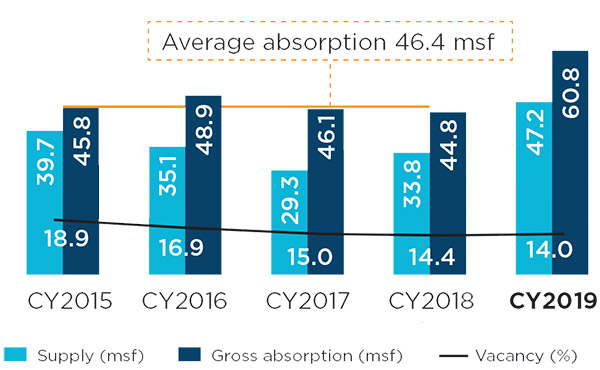
  • Absorption: Record absorption for Indian commercial office space in CY2019, c.31%1 higher compared to historical average
    • Bengaluru, REIT’s dominant market, continued as India’s leading market with c.30%1 share of historical annual leasing
  • Supply: Significant pre-commitments witnessed in CY2019 supply of c.47 msf, c.37% y-o-y supply growth average
  • Vacancy: Declined c.500 bps to c.14% in the past five years, primarily driven by technology sector demand
    • Core REIT markets of Bengaluru and Pune witnessed sub-6% vacancy levels

City-wise performance – CY2019

City Absorption2
(msf)
Supply
(msf)
Vacancy
(%)
Bengaluru 16.1 10.8 4.1 Pune 7.0 4.5 5.6 Mumbai 7.1 4.3 21.0 NCR 11.1 10.5 23.4 Embassy REIT markets 41.3 30.1 13.8 Hyderabad 12.9 13.5 10.4 Chennai 5.5 3.3 8.5 Kolkata 1.1 0.2 36.7 Other markets 19.5 17.1 14.6 Grand Total 60.8 47.2 14.0

Source: CBRE Research, Embassy REIT

Notes:

1 Based on average annual gross absorption from CY2015 to CY2018

2 Represents gross absorption figures
Demand

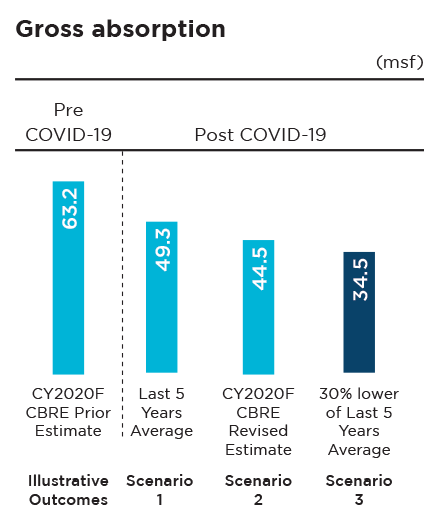
Demand impacted by 30%1 in 1Q CY2020 due to COVID-19 and is softening in short-term. In the medium-term, high-quality assets to benefit from supply shrinkage and demand from increased technology spends.

Pro forma demand analysis

Source: CBRE Research, Embassy REIT

Note:

1 Jones Lang LaSalle - India Real Estate Market Update Q1 2020 dated Apr’20

Outlook

Short-term

  • Limited impact for existing leases in Grade A properties
  • Demand likely to soften as occupiers defer decisionmaking
  • Low quality stock likely to come under intense pressure

Medium-term

  • Absorption recovery timeline uncertain – multiple possible outcomes based on lockdown time frame
  • Increased technology spends to support new lifestyles and outsourcing likely given global business pressures
  • Evolving themes such as WFH, de-densification, wellness, industry consolidation, flight to quality
  • India office demand well placed given talent pool, cost advantage and depreciating rupee

Portfolio implications

  • Limited impact on operational portfolio given asset quality, long leases, below market rents and occupier stickiness
  • c.1.4 msf upcoming expiries in FY2021, c.32% in advanced stages; no new REIT supply until FY2023
  • Opportunity given industry consolidation, preference for institutional assets and low supply in key micro-markets

Supply

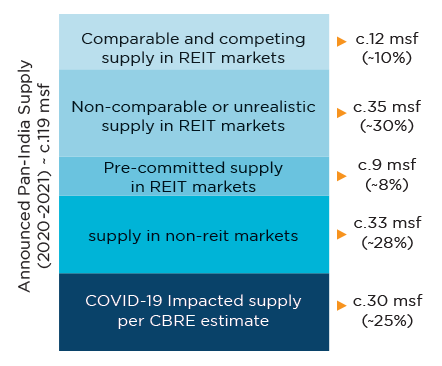
Considerable supply shrinkage from 1Q CY2020 owing to COVID-19 and likely to continue in the medium-term. Comparable and competing supply for REIT properties assessed to be even lower.

Pro forma supply analysis (2020-2021)

Source: CBRE Research, Embassy REIT Note: Comparable and competing supply has been arrived factoring supply considerations including city, micro-markets, location, project completion timing, quality.

Outlook

Short-term

  • Sharp drop likely due to COVID-19 disruptions on supply chain and labour remobilisation
  • Only well-funded developers to complete projects
  • 1Q CY2020 supply down c.32% y-o-y per C&W, trend to continue

Medium-term

  • Dramatic liquidity squeeze to disrupt new projects
  • Announced supply for next two years expected to drastically shrink by c.25% to c.89 msf per CBRE
  • Supply recovery likely to lag demand recovery

Portfolio implications

  • Comparable and competing supply in next two years is significantly lower at c.10% of announced supply
  • REIT has no near-term new supply, c.2.6 msf ongoing developments to be delivered FY2023 onwards
  • REIT developments are part of existing campuses, REIT’s low leverage to enable ongoing capex financing
  • REIT has flexibility to control supply timing over the medium-term